Moving from Json to Yaml
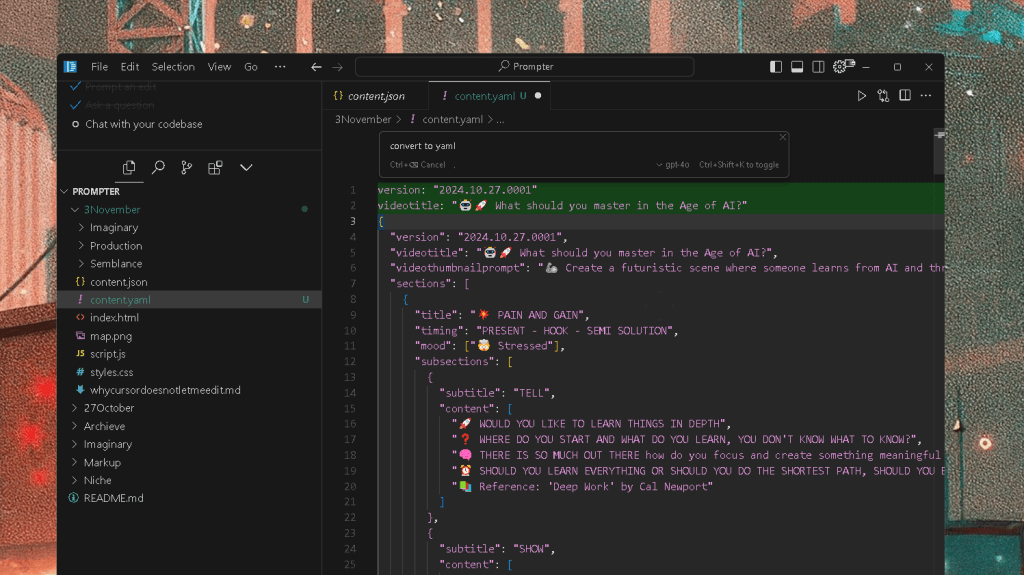
📘 Transitioning from JSON to YAML: Why YAML is the Better Choice for Configuration Data
When it comes to managing configuration files, developers often face a choice between JSON and YAML. Both formats have their strengths, but YAML offers unique advantages for handling data that needs agility and frequent updates. Recently, I switched to YAML for my prompter software's data source, and here’s why it’s a game-changer for projects requiring flexible and readable configuration.
📊 JSON vs. YAML: The Key Differences
-
JSON: Structured, widely supported, and ideal for data exchange. But, JSON’s strict syntax can make complex configurations harder to manage.
-
YAML: More readable, less verbose, and specifically designed to handle configuration data. YAML’s indentation-based structure feels closer to how we naturally organize ideas and is easily scalable.
💡 Why YAML Works Best for Configuration Data
1. 📝 Readability & Structure
YAML is designed to be human-readable and minimizes the need for brackets or quotation marks. This makes it easier to scan and understand at a glance, even with complex configurations. For example, notice how much cleaner YAML looks when defining nested data compared to JSON:
settings:
theme: "dark"
plugins:
- name: "AI Assistant"
- name: "Auto-Save"
2. 🔄 Flexibility with Changing Metadata
One of the key reasons I switched to YAML is that it’s naturally adaptable for metadata that evolves over time. YAML allows for easy additions, modifications, and deletions without impacting readability.
3. 🚀 Simpler Syntax, Faster Writing
YAML’s syntax is compact and uses indentation rather than closing brackets or commas. This structure makes it faster and more intuitive to write, especially when changes are frequent.
4. 🔧 Ideal for Configuration Files
YAML is inherently suited for configuration. Many popular tools (like Docker, Ansible, and Kubernetes) already use YAML because it offers a clear hierarchy and supports various data types, making it ideal for complex settings files.
📷 Screenshot: JSON vs. YAML for a Simple Configuration
Here’s a side-by-side comparison of JSON and YAML, illustrating the simplicity YAML brings:
JSON:
{
"settings": {
"theme": "dark",
"plugins": [
{ "name": "AI Assistant" },
{ "name": "Auto-Save" }
]
}
}
YAML:
settings:
theme: "dark"
plugins:
- name: "AI Assistant"
- name: "Auto-Save"
Notice how much cleaner and readable the YAML format is? This readability becomes especially valuable as configuration files grow.
📈 Summary: YAML for Configurations that Need Agility
If you work with data configurations that are dynamic and subject to frequent change, YAML can make your workflow significantly more efficient. By switching to YAML, I've found it easier to iterate and expand configurations in my prompter software, which ultimately speeds up development time and reduces errors.
🔗 Connect with me:
Let’s talk about how configuration management can be made simpler, faster, and more adaptable with YAML!
Imported from rifaterdemsahin.com · 2026