Why a Heated Vest Can Warm Your Entire Body
🥶 Winter is coming, and with it, the relentless chill that makes us shiver. But what if one piece of clothing could keep you warm without the bulk of layers? Enter the heated vest! Let’s break down why this modern marvel is enough to warm your entire body, thanks to the magic of blood circulation.
🩸 The Science of Warmth: Blood Circulation
Your body’s circulatory system is like an internal heating system, with your heart as the furnace. Here’s how it works:
-
Core Heat Generation: Your body focuses on keeping your core organs warm, as they are vital for survival.
-
Blood as a Heat Carrier: Blood vessels transport heat from your core to your extremities (hands, feet, etc.).
-
Thermoregulation: Your body adjusts blood flow based on external temperatures, sending more blood to the skin to release heat or conserving it in the core to retain warmth.
A heated vest acts as a personal furnace, warming your core. Once your core temperature rises, your blood efficiently distributes that warmth throughout your body. This keeps you feeling cozy, even when your fingers and toes are exposed to the cold.
🔥 Why Choose a Heated Vest?
-
Lightweight Warmth: Unlike bulky jackets, a heated vest is slim and lightweight, allowing freedom of movement.
-
Customizable Heat: Most heated vests come with adjustable temperature settings, so you’re always in control.
-
Energy Efficiency: Using rechargeable batteries, these vests can keep you warm for hours without needing constant recharging.
-
Targeted Heating Zones: Designed to warm key areas like the chest, back, and neck, maximizing heat efficiency.
🚀 Real-Life Benefits of Heated Vests
-
Outdoor Adventures: Perfect for hiking, skiing, or any cold-weather activity.
-
Work Efficiency: Ideal for workers who need to stay warm without bulky clothing.
-
Daily Comfort: Great for commuting, running errands, or even lounging at home.
📸 See It in Action
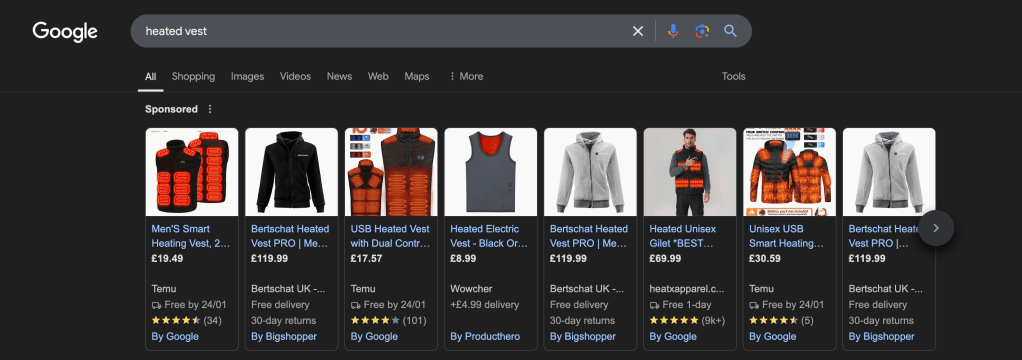
🌟 Fun Fact: Warm Blood, Happy Mood
Did you know that being warm can actually improve your mood? Staying cozy enhances blood flow to the brain, reducing stress and increasing focus. Talk about a win-win!
💡 Final Thoughts
A heated vest isn’t just a luxury—it’s a game-changer for staying warm and active in cold weather. By focusing on your body’s natural heating system, it keeps you comfortable and free to enjoy life without the chill. So, why pile on layers when one vest can do it all?
🔗 Connect with me:
-
💼 LinkedIn: https://www.linkedin.com/in/rifaterdemsahin/
-
🐦 Twitter: https://x.com/rifaterdemsahin
-
🎥 YouTube: https://www.youtube.com/@RifatErdemSahin
-
💻 GitHub: https://github.com/rifaterdemsahin
Deep Notes
To estimate the battery capacity required to heat a person wearing a heated vest for 12 hours in 5°C weather, several factors must be considered:
Key Factors
-
Heating Power of the Vest: Most heated vests consume between 5 and 20 watts, depending on the heat setting.
-
Battery Efficiency: Typically, the battery operates at 85–95% efficiency, with some energy lost to heat conversion.
-
Voltage of the Battery: Heated vests often use a 5V or 7.4V rechargeable battery.
-
Desired Heating Duration: 12 hours in this case.
Calculation Steps
1. Determine Power Consumption
Let's assume the vest consumes:
-
Low Setting: ~5W
-
Medium Setting: ~10W
-
High Setting: ~15W
2. Energy Needed
Energy is calculated as: Energy (Wh)=Power (W)×Time (h)\text{Energy (Wh)} = \text{Power (W)} \times \text{Time (h)}
For a medium setting (10W) over 12 hours: 10W×12h=120Wh10W \times 12h = 120Wh
3. Battery Capacity
Battery capacity is measured in milliampere-hours (mAh). Convert watt-hours (Wh) to mAh: Capacity (mAh)=Energy (Wh)×1000Voltage (V)\text{Capacity (mAh)} = \frac{\text{Energy (Wh)} \times 1000}{\text{Voltage (V)}}
For a 7.4V battery: Capacity (mAh)=120×10007.4≈16,216mAh\text{Capacity (mAh)} = \frac{120 \times 1000}{7.4} \approx 16,216mAh
Final Estimate
-
Low Setting (5W): ~8,108mAh
-
Medium Setting (10W): ~16,216mAh
-
High Setting (15W): ~24,324mAh
To heat for 12 hours in 5°C weather, you need:
-
A 7.4V battery with at least 16,216mAh for medium settings.
-
Consider adding 10–20% more capacity to account for efficiency losses and colder conditions.
Let me know if you'd like a deeper breakdown or recommendations for batteries! 😊
Imported from rifaterdemsahin.com · 2025