Embracing Multiple Convergence Points in Video Production: A Reflection
Before talking it with the weekly meetings
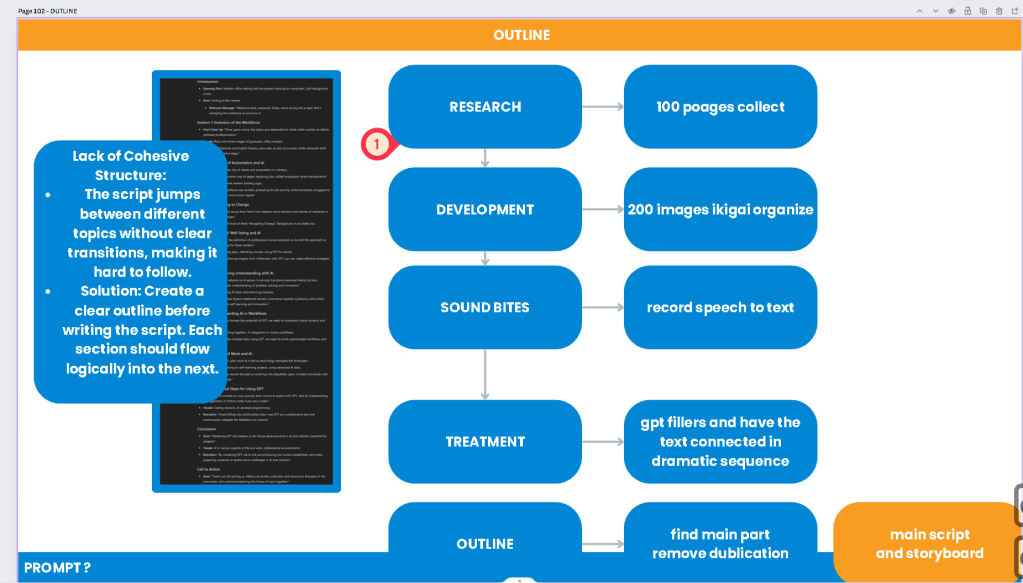
After the weekly meeting
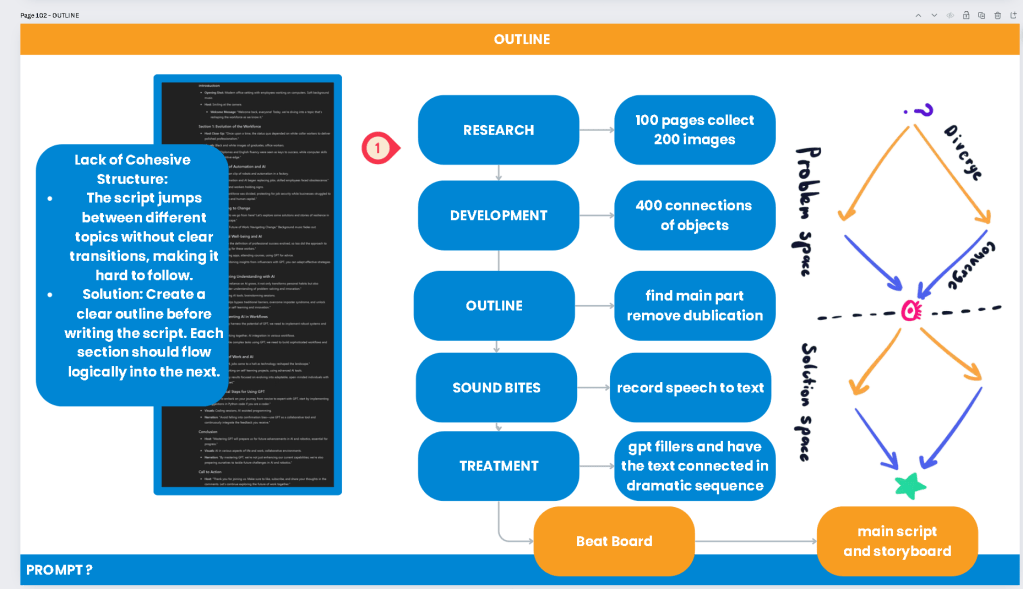
In the journey of video production, the process is just as critical as the final product. Recently, I’ve been reflecting on my workflow and the continuous feedback I receive during our weekly meetings. This reflection has led me to fine-tune a critical aspect of my process: the importance of multiple convergence points rather than relying on a single, overwhelming "big bang" moment.
The Outline: A Guided Process
The image you see above represents the structured approach I follow, from research to treatment, and eventually the final script and storyboard. The workflow is quite detailed:
-
Research: This is where the foundation is laid—collecting 100 pages of information and 200 images to set the stage for development.( Google Docs )
-
Development: Next, I map out 400 connections between objects, ensuring a robust network of ideas that are interlinked and ready for refinement. ( Canva Whiteboard )
-
Outline: This step involves finding the main parts of the content and eliminating any redundancies. It’s about distilling the information into a coherent narrative. ( GPT > Google Sheet )
-
Sound Bites: Converting speech to text ensures that the dialogue and voiceovers are aligned with the visual and narrative flow. ( Apple note taking walking )
-
Treatment: Finally, with the help of AI and other tools, I add fillers and connect the text in a dramatic sequence, bringing the script to life.
Diverge and Converge: The Balancing Act
A critical aspect of this process is the continuous dance between diverging and converging. During the research and development phases, I allow ideas to diverge, exploring multiple possibilities and directions. This broad exploration is essential to avoid tunnel vision and to ensure that all creative avenues are considered.
However, what I’ve learned through feedback—especially from Michael in our recent meetings—is the importance of not just having one big convergence point where everything comes together. Instead, it’s about having multiple convergence points throughout the process. These points allow for the gradual synthesis of ideas, making sure that the final product is well-rounded and polished, without being overwhelming at any single stage.
The Impact of Feedback
The shift to multiple convergence points has been a game-changer. Instead of pushing for a single, all-encompassing moment where everything magically falls into place, I now break the process into more manageable convergence stages. This not only makes the workflow smoother but also reduces the risk of missing critical details that could get lost in a more hasty convergence.
Thanks to the feedback from Michael and others in our weekly meetings, I’ve adopted this approach, which has made my video production process more resilient and adaptive. It’s a method that ensures all ideas are vetted, all angles are considered, and nothing is left to chance.
Conclusion
In the creative process, there’s always room for growth and refinement. Incorporating multiple convergence points into my workflow has allowed for a more thorough and thoughtful production process. It’s a strategy I’ll continue to refine, with gratitude to the continuous feedback from my team, proving that collaboration and iteration are at the heart of successful content creation.
This post reflects on how you've adapted your process based on feedback and the significance of diverging and converging in phases. Feel free to adjust any part of this draft to better match your style or the specific message you want to convey!
Imported from rifaterdemsahin.com · 2024