The Double Diamond Model: From Complexity to Clarity
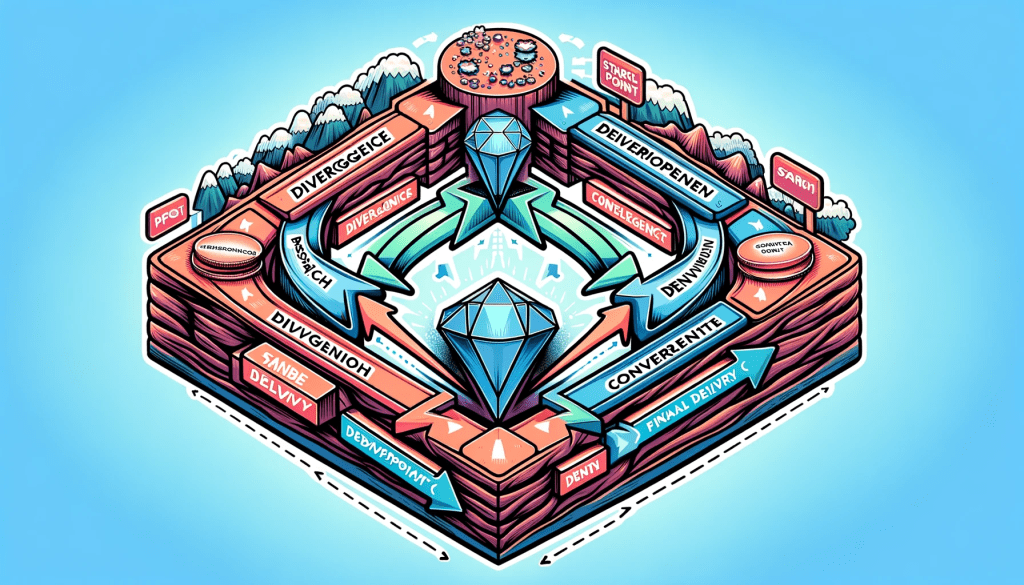
In the world of design and innovation, navigating the path from a starting point to a final delivery can often feel like an intricate journey. One of the most effective frameworks for understanding this process is the Double Diamond model. This model, illustrated by the diagram above, succinctly captures the stages of divergence and convergence that teams go through during research and development. Let's delve into this model and explore its implications for managing complexity and driving successful outcomes.
Understanding the Double Diamond
The Double Diamond model, developed by the British Design Council, is a visual representation of the design process. It consists of two main phases: divergence and convergence, each appearing as a diamond shape on the diagram.
-
Starting Point: Every project begins with a starting point, where the problem or objective is identified. This initial stage sets the direction for the subsequent process.
-
Divergence: The first diamond represents the phase of divergence. During this stage, the goal is to explore a wide range of possibilities and gather as much information as possible. This often involves extensive research to uncover insights, understand user needs, and identify potential opportunities. The complexity increases as more ideas and data points are considered.
-
Research: This phase is crucial for expanding the knowledge base. It involves user research, market analysis, and stakeholder interviews. The aim is to gather diverse perspectives and challenge assumptions, leading to a broad understanding of the problem space.
-
Convergence: After gathering a wealth of information, the next step is to synthesize and narrow down the options. This convergence phase involves evaluating the insights gained, identifying patterns, and focusing on the most promising solutions. The complexity starts to decrease as the team zeroes in on specific ideas.
-
Development: The development phase involves refining and iterating on the selected ideas. Prototypes are built, tested, and improved based on feedback. The focus is on translating concepts into tangible solutions that meet user needs and business objectives.
-
Final Delivery: The journey culminates in the final delivery, where the refined solution is launched. This stage marks the transition from development to implementation, ensuring that the product or service is ready for the market.
Managing Complexity Through Divergence and Convergence
The Double Diamond model emphasizes the importance of both expanding and narrowing the scope of exploration. By intentionally diverging, teams can uncover hidden opportunities and innovative ideas. Conversely, the convergence process ensures that these ideas are filtered and refined into viable solutions.
-
Increase Complexity (Divergence): During the divergence phase, the complexity increases as teams explore multiple directions. Embracing this complexity is essential for thorough research and ideation. It encourages creative thinking and prevents premature narrowing of options.
-
Decrease Complexity (Convergence): In the convergence phase, the focus shifts to simplifying and streamlining. By reducing complexity, teams can concentrate on developing practical and impactful solutions. This phase is crucial for aligning the project with strategic goals and user needs.
Conclusion
The Double Diamond model serves as a valuable guide for navigating the complexities of design and development. By balancing divergence and convergence, teams can effectively manage the journey from a starting point to final delivery. Embracing this structured approach allows for thorough exploration, informed decision-making, and the creation of innovative solutions that address real-world challenges.
As you embark on your next project, consider applying the principles of the Double Diamond model. Embrace the initial complexity, dive deep into research, and confidently converge towards a refined and impactful final delivery. This balanced approach can unlock the full potential of your team's creativity and drive successful outcomes.
Imported from rifaterdemsahin.com · 2024