"Orchestrating Visual Stories: Mastering Video Production Workflow with Digital Tools"
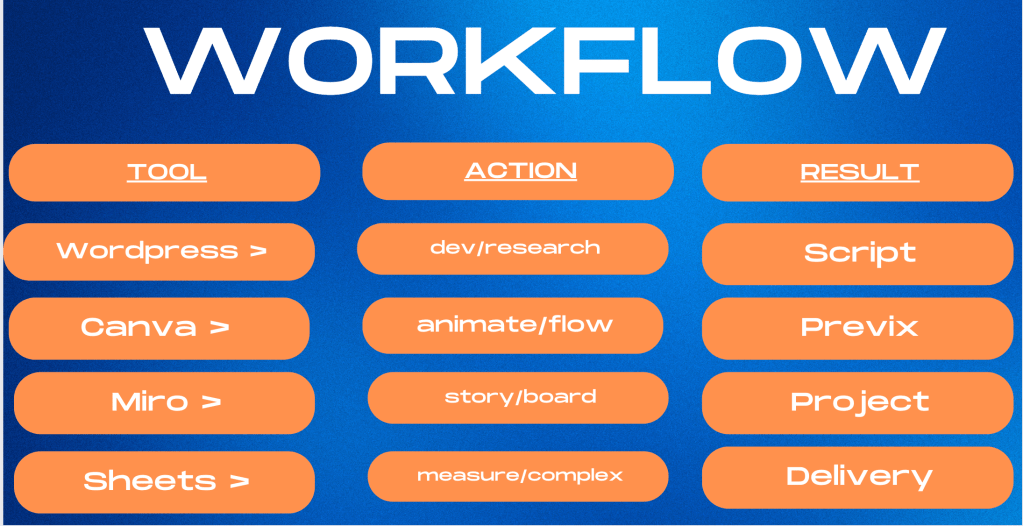
Creating a video production is an intricate process that involves various stages, from initial development to the final delivery. To navigate through this multifaceted process effectively, it's crucial to have a clear workflow that utilizes the right tools for each step. Here's a breakdown of an efficient video production workflow using popular digital tools.
Stage 1: Development/Research with WordPress
The journey begins with conceptual development and research. For this stage, the use of WordPress is instrumental. WordPress, commonly known for its blogging capabilities, can also serve as a robust project management tool. By creating a private blog or project page, team members can post research, ideas, and script drafts. Collaborative plugins can be used to facilitate discussions, feedback, and revisions, leading to the creation of a polished script.
Stage 2: Storyboarding with Miro
Once the script is ready, the next step is to visualize the scenes. This is where Miro, an online collaborative whiteboarding platform, comes into play. Miro can be used to create storyboards that map out each shot. It’s a digital canvas where team members can sketch scenes, add notes, and arrange them to outline the video’s flow. This interactive approach ensures that everyone is aligned on the visual direction of the project.
Stage 3: Design and Animation with Canva
With the storyboard as a guide, the design phase begins. Canva is a versatile graphic design tool that simplifies the creation of animations and flowcharts. Whether it's designing animated segments, transitions, or graphical elements for the video, Canva’s user-friendly interface allows for quick iteration and prototyping. This stage results in a ‘previx’ – a preliminary visualization of the final product.
Stage 4: Measurement and Complexity Handling with Google Sheets
No production is without its complexities, and managing them requires meticulous planning. Google Sheets is an excellent tool for measuring progress, tracking tasks, and managing the budget. It's where all the project's metrics are quantified. From schedules to resource allocation, Sheets can hold all the data necessary to ensure the project stays on track.
Final Stage: Delivery
The culmination of all these stages is the delivery of the final product. This step represents the convergence of scripting, storyboarding, designing, and project management into a single, cohesive video ready for the audience.
Conclusion
In the world of video production, efficiency and organization are key. Leveraging digital tools like WordPress, Miro, Canva, and Google Sheets can streamline the workflow, enhance collaboration, and lead to the creation of impactful videos. Each tool brings its strengths to a stage of the production process, and together they form a powerhouse that can handle the demands of video creation from conception to completion.
Imported from rifaterdemsahin.com · 2024